Do you plan to sell a business, real estate, Bitcoin, or other high-value asset? The tax strategy you use for this sale dramatically impacts how much wealth you keep, so it’s critical to hire the right capital gains tax advisor. But not all advisors are created equal, so how do you know who to choose?
If you want to make the most of your sale and avoid unnecessary tax burdens, you must understand what to look for—and avoid—in your advisor. In this blog we’ll cover common mistakes to steer clear of when hiring a capital gains tax advisor.
Mistake #1: Thinking Any CPA or Tax Preparer Will Do
It’s easy to assume that because someone has “CPA” after their name, they’re equipped to guide you through complex capital gains scenarios. But general accounting knowledge doesn’t always translate to expertise in advanced tax deferral strategies. If your advisor has only handled standard income tax returns or small business filings, they may be out of their depth when it comes to installment sales, Deferred Sales Trusts (DST), or asset sales with multimillion-dollar gains.
When selling properties, businesses, or cryptocurrency investments with significant appreciation, you need someone who does more than just file forms. They should be equipped to anticipate tax consequences, structure your sale for maximum deferral, and protect you from triggering unintended tax events. If you choose a generalist, you may miss out on key strategies that could save you hundreds to thousands of dollars in taxes.
For example, say you plan to sell a commercial building worth $3 million. If you work with a tax advisor who doesn’t understand how to structure a DST to defer capital gains taxes, they could leave you with a significant and immediate tax bill. However, an advisor specializing in DSTs could help you defer that liability, allowing you to reinvest your gains and preserve your wealth over time.
Mistake #2: Prioritizing Low Fees Over Long-Term Value
Many investors look for the lowest-cost option when hiring an advisor, thinking they’ll save money. But in tax strategy, what you save in fees may cost you far more in taxes. A qualified capital gains tax advisor doesn’t just do your taxes. They create and execute strategies that protect your wealth.
Perhaps you’re selling a tech startup and stand to make a $5 million gain. A basic CPA may charge you $3,000 to file the return, while a specialized team might charge more to design and implement a tax deferral structure like a DST. It might seem expensive at the outset, but such a strategy can help you defer millions in taxes, giving you more to invest and grow. In that light, the upfront fee is an investment in long-term gains, not just a cost.
You have to ask yourself: Are you hiring someone to save you $1,000 today, or to help you protect seven figures tomorrow?
Mistake #3: Overlooking the Advisor’s Track Record and Case Experience
In the capital gains space, experience matters more than credentials alone. If an advisor hasn’t structured real-world transactions involving real estate exits, business sales, or high-value crypto divestments, they may be learning on your dime. Worse, they might steer you toward strategies that either don’t apply to your situation or put you at risk of an IRS audit.
A seasoned advisor will provide information upfront. This may include explaining their IRS compliance or how they’ve helped clients in similar situations, such as setting up DSTs. If an advisor hesitates when you ask for this information or speaks in vague generalities, take note. You deserve clarity, confidence, and proof of results before entrusting someone with your financial future.
Mistake #4: Underestimating IRS Compliance and Legal Safeguards
One of the most dangerous mistakes you can make is working with someone who uses aggressive or unproven tax strategies that don’t align with IRS guidelines. While some advisors market flashy schemes that promise total tax elimination, the truth is that if it sounds too good to be true, then it probably is. You don’t want to find yourself facing penalties, back taxes, or audits because your advisor cut corners or misunderstood compliance rules.
DSTs, for example, are legitimate and can withstand IRS audits when properly structured. But they must be set up by a qualified capital gains tax advisor who follows strict legal frameworks.
Ask about audit history, attorney involvement, and how the strategy complies with IRS code. A trustworthy advisor will welcome your direct questions and provide transparent answers.
Mistake #5: Choosing a Short-Term Thinker Instead of a Long-Term Partner
Tax deferral strategies often unfold over time, and your financial life will evolve. That’s why it’s essential to work with someone who helps beyond a single transaction. The tax advisor you choose should understand your long-term goals like retirement planning and generational wealth transfer.
If your advisor only talks about this year’s taxes and doesn’t ask about your broader financial picture, they may not be the right fit. You need someone who sees beyond tax savings; they should be able to adapt your strategy as laws change and as your needs shift.
Mistake #6: Expecting One Person to Do It All
The reality is that sophisticated capital gains planning requires collaboration. You’ll likely need a tax attorney, a deferred sales trust trustee (if you’re using a DST), and a financial advisor who can help manage reinvestments. Relying on just one individual may result in blind spots or incomplete execution.
Look for a team-oriented advisor. Someone who knows when to bring in additional experts and how to coordinate a seamless plan across all parties. The best capital gains advisors operate as part of a trusted network, not as lone wolves.
Find the Right Fit
Hiring the right capital gains tax advisor could be one of the most important financial decisions you make, especially if you’re on the verge of a significant liquidity event. Avoiding these common mistakes will help you find a professional who understands advanced tax strategies and will align with your long-term vision.
Video

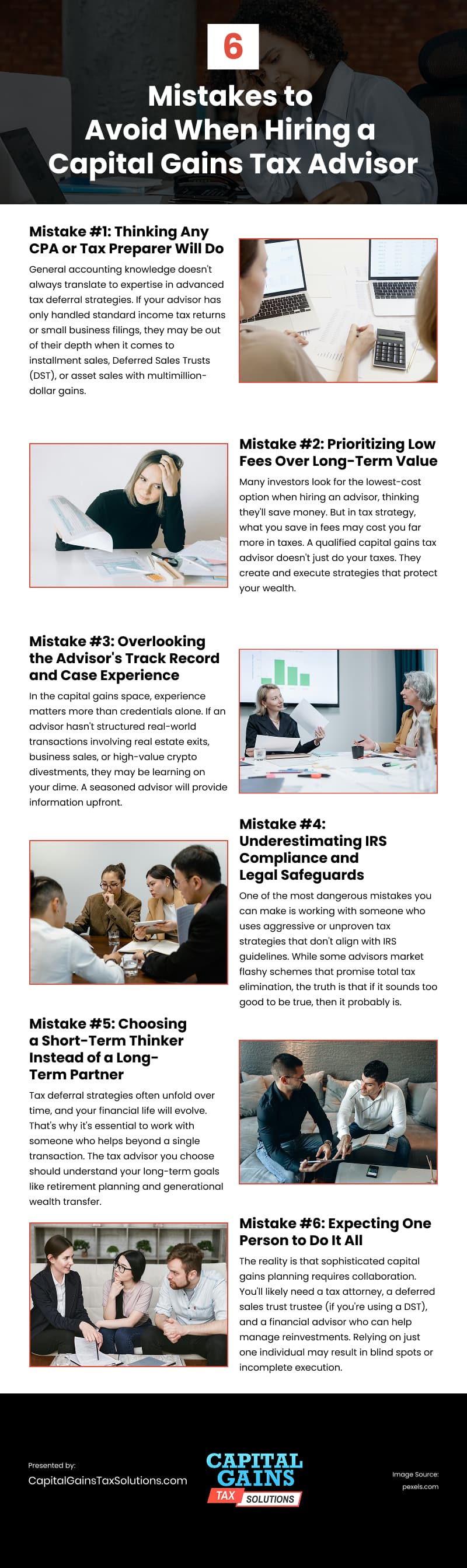
Infographic
Selling high-value assets demands smart capital gains tax planning. Many lose wealth by treating it like routine filing. This infographic reveals key mistakes and shows how the right advisor can help you preserve more of what you’ve earned.