Capital Gains Tax Deferral On Sale of Farmland
The price of farmland has been increasing steadily for several years now. Many farmers and ranchers are ready to cash in by selling land to eager commercial and residential real estate developers. However, if you sell highly appreciated land and assets, you may owe a significant chunk of your profits to the IRS in the form of capital gains taxes.
The tax laws surrounding the inheritance and sale of farmland differ somewhat from the sale of ordinary real estate or appreciated businesses. While everyone wants to know how to avoid capital gains taxes when selling farmland, let’s start by reviewing current tax laws and how they might impact your exit strategy.
What Are Capital Gains Taxes?
Capital gains taxes are levied when you sell any investment for a profit. A profit is the difference between the cost basis (the price at which you bought the asset or property) and the selling price. If you purchased a farm for $1 million, and 15 years later, it was worth $6 million, you wouldn’t owe any taxes. But as soon as you sell the property and receive the profit, you realize a gain of $5 million, and you will owe capital gain taxes on that $5 million.
If you have owned an asset for less than a year, the profit will be treated the same as income, and you’ll pay according to your income tax bracket. If you have owned the property for more than a year, you will pay 0, 15, or 20 percent, depending on your taxable income. You must pay the applicable taxes in the year you receive the profit.
Capital Gains and Farmland
All appreciated assets–including stocks, real estate, businesses, art, and cryptocurrency–are subject to capital gains taxes. However, the way that all of those assets are taxed is not necessarily the same. Some special rules apply to selling farmland.
What Qualifies as Farmland?
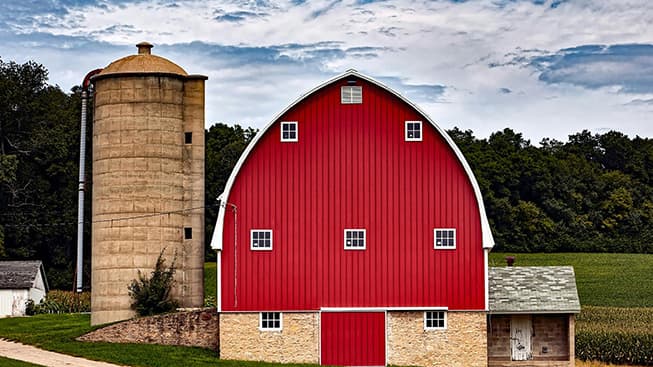
The IRS defines farmland as land used to cultivate agricultural (animal) or horticultural (plant) commodities for profit. Some examples would be a large commercial dairy farm, a Christmas tree farm, land used to raise goats for making cheese to sell at a farmer’s market, or a nursery.
How is it Different from Real Estate?
While a family farm and a vacation property are both real estate, tax and finance professionals treat them differently. Residential and commercial real estate are assigned a specific use life, and their value depreciates over time. This is taken into account when calculating tax liabilities. Undeveloped farmland, however, does not depreciate over time. According to tax laws, land has an unlimited useful life.
Calculating taxes when selling a farm can be complicated, and we recommend working with tax professionals. If you own a working farm, it most likely consists of the raw land, buildings, equipment, and/or livestock. All of these entities are taxed slightly differently. To maximize your profit, you will need the guidance of experienced and qualified tax professionals.
Stepped-Up Basis
Here’s where it gets even more complicated. The difference between the sale price and your cost basis determines your profits. So, determining the cost basis is crucial. If you are the original owner, your profits would be the amount you sell the farm for, minus the price you bought it for. Capital improvements can be added to the cost basis, reducing the overall tax liability.
If you have inherited a legacy farm, your cost basis is the actual market value at the time you inherited. So, if you inherit a farm and then sell it a year or two later, there’s a high likelihood that you won’t owe very much in taxes. However, if you inherit a farm and then sell it 20 or 30 years later, it will probably appreciate significantly from the time of your inheritance, and your capital gains tax requirements will be large.
Minimizing Your Tax Liability
There are a few ways to reduce your tax liability or achieve capital gains tax deferral on the sale of your farmland.
Pass It on to Your Heirs
If you transfer your property to the next generation, they will receive the benefits of the step-up in cost basis, and if they sell it soon after, they won’t owe very much in taxes. The risk you run here is that the value of the land is susceptible to the ups and downs of the market, and you might end up losing money while trying to save money in taxes.
1031 Exchange
If you are selling your farmland but want to continue farming, you can utilize a 1031 exchange. This will allow you to reinvest your profits, tax-free, into another “like-kind” property. You have to reinvest the entire proceeds of your sale, and you have a limited window of time to find and purchase an appropriate property.
Offset with Losses
If you have underperforming assets outside of your farmland, you can sell them at a loss and use the losses to offset your gains and reduce your tax liability.
Deferred Sales Trust
With a Deferred Sales Trust, you sell your farm to an independent, third-party trust in exchange for a promissory note (instead of selling directly to a buyer). This note outlines the installment plan. The trust then sells the farm to the buyer and receives the profits. Per the installment contract, the trust can reinvest the proceeds and repay you in installments over time. You only owe capital gains tax if principal is included in the installment payments you receive.
If the note is structured to pay only interest payments only ordinary income tax would be owed keeping profits from your sale 100% deferred. This allows you to defer receipt of your profits and, therefore, achieve capital gains tax deferral on the sale of your farmland.
What is a Deferred Sales Trust?
With a Deferred Sales Trust, you sell your farm to an independent, third-party trust in exchange for a promissory note (instead of selling directly to a buyer). This note outlines the installment plan. The trust then sells the farm to the buyer and receives the profits. Per the installment contract, the trust can reinvest the proceeds and repay you in installments over time. You only owe capital gains tax if principal is included in the installment payments you receive. If the note is structured to pay only interest payments only ordinary income tax would be owed keeping profits from your sale 100% deferred. This allows you to defer receipt of your profits and, therefore, achieve capital gains tax deferral on the sale of your farmland.
Who Qualifies for a Deferred Sales Trust?

A Deferred Sales Trust works for anyone selling highly appreciated assets. The only requirement is that it be a large enough gain for a tax deferral strategy to make sense. As long as your net gain is $1 million or more and you will have net proceeds totaling $1 million or more, we can help you.
The Deferred Sales Trust might be a good fit for your farm sale if:
- You want to get out of farming and real estate and live off your investments.
- You want to buy real estate on your own timeline, with the possibility of selling high and waiting for the right investment opportunity while deferring your taxes.
- You feel trapped by capital gains taxes that could take up to 37% of your proceeds.
- Your net worth is above $11 million (single) or $22 million (couple) and you want to move equity out of your taxable estate and save yourself the 40% estate tax.
- You want to secure your legacy now instead of waiting for your farmland to be passed onto your heirs.
How Can a Deferred Sales Trust Help with Selling Farmland?
The Deferred Sales Trust has a number of advantages over other tax strategies. If you want to retire from farming, a 1031 exchange won’t work for you, as you would be required to reinvest the entirety of your profits back into like-kind real estate.
Even if you want to continue to own land or real estate, if you use a 1031 exchange, you are constricted by the stringent time requirements. You have only 45 days to locate your second property and 180 days to close on it, or your 1031 exchange will fail. With a 1031 exchange, you are subject to the ups and downs of the real estate market. Without flexible timing, you may be able to sell your land when prices are high, but that means you have to buy land again while real estate prices are still high.
Even if you want to sell your land and reinvest in real estate, a Deferred Sales Exchange allows you to optimize your timing. It gives you the freedom to sell high and buy low, maximizing your profits.
Why Use Capital Gains Tax Solutions?
Navigating the complexities of capital gains taxes on farmland requires professional assistance. Let us help you find a tax strategy built for your unique needs.
Years of Experience
We have over 20 years of experience in investment real estate, helping clients invest in multi-family brokerage, commercial real estate, and raw land. We have assisted clients in deferring taxes through 1031 exchanges, Delaware Statutory Trusts, and Deferred Sales Trusts.
We have over 14 years of collective experience in Deferred Sales Trusts, helping clients to transform their wealth through deferred taxes and smart investments.


Access to Experts
Not only do you get access to an experienced Deferred Sales Trust trustee, but we partner with CRE syndicators, tax attorneys, CPAs, financial advisors, and real estate professionals to ensure that we can meet all of your financial goals when you exit your farmland.
Tried and Tested
While not as well known as the 1031 exchange or Charitable Remainder Trust, the Deferred Sales Trust is not new. It has been tested in a wide variety of financial markets for over 30 years. At Capital Gains Tax Solutions, we have executed thousands of transactions.
The Deferred Sales Trust has successfully been tested by the IRS with 14 IRS audits and eight audits at the state level (including three recent California audits) with no changes. An added benefit of working with Capital Gains Tax Solutions is the peace of mind that each DST has lifetime audit defense.

How Does it Work?
Step One: Free Phone Call Consult
Before you start taking steps to exit your farmland, reach out for a free consultation to see if a Deferred Sales Trust can help you. In this consultation, you will:
- Get a walk-through of all of your capital gains tax deferral options.
- Begin to develop a thorough understanding of the Deferred Sales Trust.
- Get clarity on your own tax liability and how the DST can work for you.
- Learn about actionable changes to make to your deal right now to give you capital gains deferral options in the future.
- Have no obligation to continue with us if you decide not to pursue a DST.
Step Two: Conditional Engagement Agreement
If you decide to move forward, the second step is to sign a conditional engagement agreement.
- This is 100% conditional, with no obligation to continue and no cost to you until you close with the Deferred Sales Trust.
- You will work with a DST trustee and a tax attorney to build the structure of the Deferred Sales Trust to meet your financial objectives.
- You want to complete this step before you begin closing your transaction. Timing is important. Even if you aren’t sure about the Deferred Sales Trust, you want an exit strategy in place to give you options.
Step 3: Make a Decision and Get Clarity
- Once you have made a decision we will sit down with you, your CPA, our tax attorneys, and financial advisors to really dig deep and make sure you feel like an expert in the Deferred Sales Trust.
- We will spend time going over investment options and your financial goals, as well as your risk tolerance, to build an investment plan catered to you.
- We will give you a chance to talk with past clients to hear their stories directly and get examples of how the Deferred Sales Trust worked in situations similar to yours.
Step 4: Execute
- If you want to use the Deferred Sales Trust, you have to decide before the close of escrow.
- We will work with the closing attorneys to make sure everything is structured properly and ready to go.
- Upon closing, you will receive a promissory note from us outlining the details of how you want to be paid back over time.
- Your capital gains taxes will be deferred.
- We will invest your funds based on your approval and risk tolerance.
- We will turn your tax liability into an income-generating asset.
You See Challenges, We See Opportunities
Facing the prospect of high capital gains taxes can feel overwhelming. Let us help you build an exit plan for your farm sale that gives you financial freedom, unlocks new possibilities, and creates more wealth for you and your posterity. The time to act is now–get a plan in place before you move forward with a sale. Call us today and see how a Deferred Sales Trust can transform your wealth.