
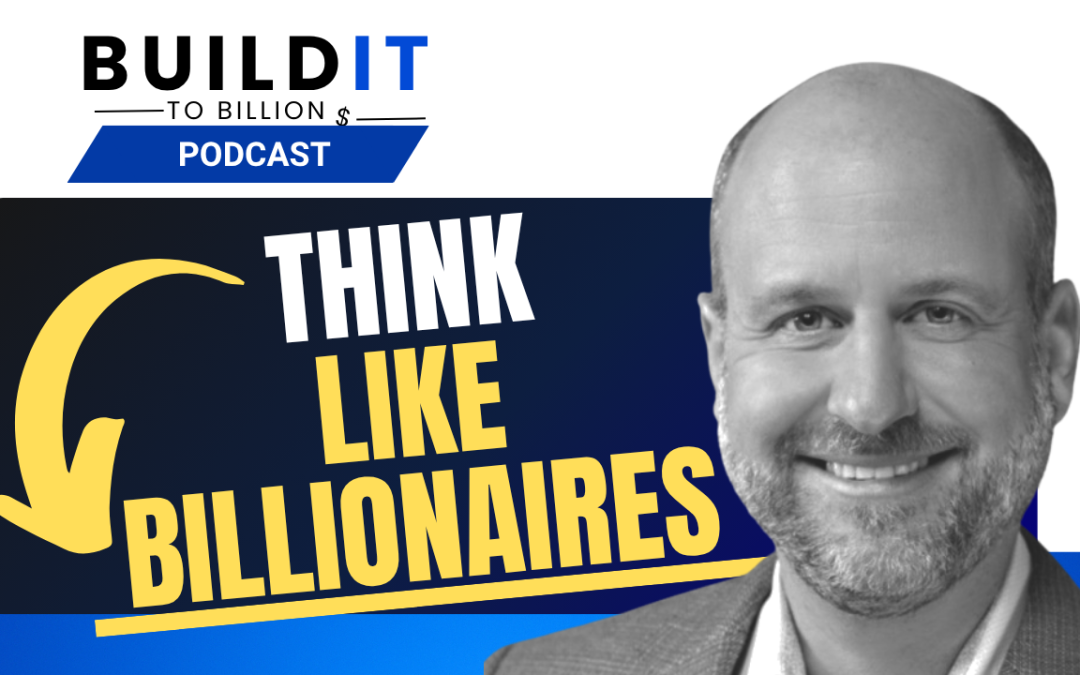
Sarti is the chief executive of Calabasas-based Morton Wealth, an investment advisor with assets under management of more than $2 billion. Sarti, who earned his MBA from the UCLA Anderson School of Management, first joined Morton Wealth as chief investment officer in 2004. He then served as a principal at Crosscourt Capital Management, returning to Morton Wealth in 2011 as vice president. He has also held the titles of co-president and co-chief executive at the company prior to taking on his current role. Sarti is also a member of the Forbes Finance Council.
Episode Highlights Here:
Brett:
Before we jump into this episode, I wanna invite you to join our community to help you become a better steward scale to billions and ultimately give more or all of it away. All I want you to do is to click the subscribe button right now. I love your support. It’s incredible to see your comments, and we’re just getting started. I can’t wait to go on this journey with you. Thank you so much for subscribing. It means the world to me. Welcome to the build to billions podcast where we got successful entrepreneurs and investors on their journey from millions to billions. We believe that the key to scaling your wealth and compounding your life starts every single day with a mindset and practice of stewardship over ownership. Our ultimate goal is to help you scale and compound your wealth and life so you can give more all that away to help envy. Peace, I’m your host today, Brett Swartz, in each episode, we’re joined by some of the world’s top millionaires, billionaires and entrepreneurs. They share their principles, values, secrets and wisdom, providing each of us with the insights we need to reach the next level of success, faith and impact. I’m excited about our next guest. He’s out of the Southern California region. He’s the CEO of Morton wealth, and they are here to help bring and help us build and create and preserve more wealth. He serves individuals and families and business owners on either whether they’re they’re curious about alternative investments or building wealth or risky learning how to build what’s called discipline, investment mindset. That’s what we’re talking about today. Please welcome to the show with me. Jeff Sarti, Jeff, how you doing? Doing great. Brett, nice to meet you. Likewise, and for our listeners, get to know for the first time, would you give us just a little bit more about your amazing background? I mean, you guys got over 2 billion under management now, 50 employees, 1000 client relationships, and you’ve got a fascinating background, it’d be great to hear from you. Yeah, yeah.
Jeff:
I’d be happy to give you a little background, and I’ll talk definitely about kind of what makes us different, but maybe just for a little bit of context, we typically are the financial quarterback in our clients lives. So you know, we’ll help them on their roadmap to achieve their goals, whether it’s towards retirement or some other goal, and that’s across a variety of things. You know, it’s helping them diversify their portfolio, doing retirement, cash flow, planning, tax strategies, insurance, estate strategies, you name it. That being said again, what really makes us different is how we invest and we how we think about the world. And I think we invest in a very different way. And I think the way I’d put it is we are a voice, or really an option, for what I’d call a healthy skeptic. And maybe I could define what a healthy skeptic is, but maybe I’ll start, if it’s okay with you, maybe defining what’s not a healthy skeptic. So for like, 90% of the people, they’re really happy with the status quo, right? And there’s nothing wrong with that, right? They’re happy with what’s worked in the past. I feel should work going forward. So maybe it’s a 6040, stock bond portfolio with a little bit of commodities in real estate, etc, and the lion shares of firms out there, they serve those needs? Well, there are plenty of excellent firms that do just that. Now, on the flip side, there’s potentially 5% of the population. This is still not quite the healthy skeptic, but maybe they’re more like doom and gloom, right, maybe even mixed with a little bit of conspiracy theory in there. So they’re going to be all in cash or maybe very heavy and precious metals and maybe shorting the market. So then there’s this third category, people that I go back to, what I think is the healthy skeptic that I think straddles those two groups. On the one hand, they they’re more optimistic, right? They’re like the status quo, and they want to participate in the economy and be invested and generate healthy returns along with the growth in the economy. But then put on the flip side, like the doom and gloomers, they have, what, again, I’d say, is a high degree of skepticism on the markets, the economy, etc. I’d say, starting like with the stock market, I think they’re very skeptical of stock market. We, of course, invest in stocks, but we have less than most traditional managers, because with our healthy skeptics, I think there’s a lot of concern around the stock markets. They think it’s more than anything, a popularity contest, not really driven by fundamentals. Element of gambling feels like sort of a casino type environment. So I think they’re skeptical about stocks. In addition, I think they’re skeptical about economic statistics. Simple example would be like inflation statistics, right? We all know that reported inflation over the last several decades is lower than actually when you go to the grocery store. And then the last point that I’d say there, they express some degree of skepticism. It’s around policy, and this is the biggest issue and concern for us talking about monetary and fiscal policy. A lot of concerns around the imbalances out there. So whether it’s 15 years of 0% interest rates, money printing galore, or our debt levels that are just absolutely out of control on the federal on the fiscal side, I think again, our clients come to us. They’re not economists, but they intuitively feel that there’s no free lunch. And there feels like there should be a cost to some of these policies, and as a result of that, they want to just build up somewhat of a more resilient, diversified portfolio than you can find in traditional sort of status quo land.
Brett:
So if you like this little short clip of the interview I just did, click over here to watch the full interview, and please don’t forget to subscribe. Thanks so much everybody.
You.
Watch the episode here:
Important Links:
About Jeff Sarti

Jeff Sarti serves as Morton Wealth’s Chief Executive Officer. Morton Wealth is a registered investment advisor with assets under management of over $2 billion, 50+ employees and 1,000+ client relationships. Jeff’s role is to lead the company’s mission of empowering better investors. This mission focuses on helping Morton’s clients achieve their financial goals and get the most life out of their wealth but also on Morton’s employees to help them achieve their personal goals and get the most life out of their career. He is the author of a quarterly newsletter series titled Perspective with Jeff Sarti that shares his take on why challenging the status quo is crucial when navigating the financial markets. He is also involved with Forbes Finance Council, a community of respected leaders who are selected based on their thought leadership and depth and diversity of experience in the financial services industry.
Jeff earned his Bachelor of Science degree in biology from Stanford University and his MBA in finance from the Anderson School of Business at the University of California, Los Angeles. Jeff is a CFA® charterholder.
- capitalgainstaxsolutions.com
- Capital Gains Tax Solutions Facebook
- Capital Gains Tax Solutions Twitter
- Capital Gains Tax Solutions Tiktok