
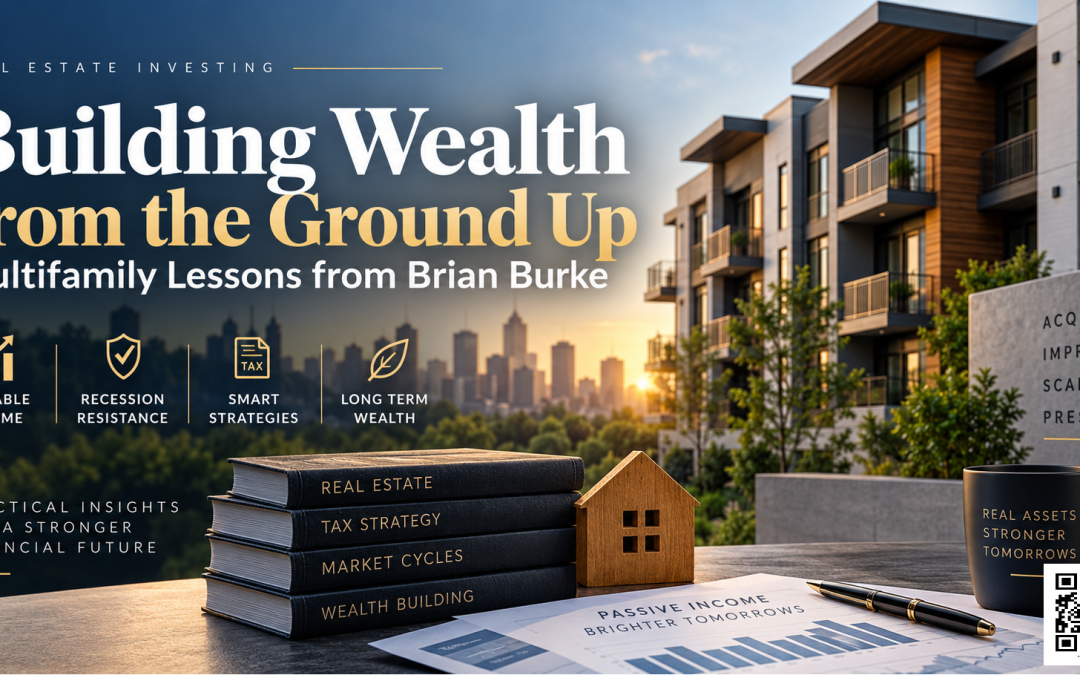
For more than three decades, real estate investor and author Brian Burke has built, scaled, and optimized real estate portfolios across the U.S. His journey from buying a single rental home to overseeing more than $500 million in real estate acquisitions, 3,000+ multifamily units, and 700+ single family homes offers a roadmap for investors who want to grow wealth predictably and sustainably.
In a recent conversation on the Capital Gains Tax Solutions Podcast, Burke shared practical insights on navigating market cycles, optimizing tax strategy, and building a resilient real estate investment business. His experiences are especially valuable for investors seeking recession resistance, scalable passive income, and long term wealth preservation.
From Humble Beginnings to Vertically Integrated Real Estate Operator
Burke’s real estate career began with a single rental house. After several successful fix and flip projects, he scaled aggressively during the post 2008 downturn, a period he credits as a major catalyst for his growth. Distressed inventory was plentiful, and his platform was optimized to acquire properties most investors were too fearful to touch.
But while single family opportunities eventually tightened, one asset class continued offering scalability, stability, and nationwide presence: multifamily housing. Over the last decade, Burke has shifted nearly all acquisition efforts into apartments across markets like Texas, Georgia, Florida, and the Carolinas.
His approach illustrates a key lesson: great investors rotate toward asset classes with the greatest runway, not just the greatest hype.
Why Multifamily Offers Durable Wealth Building Potential
Burke emphasizes multifamily for several strategic reasons:
1. Scalability & Market Flexibility
Every U.S. market has multifamily assets, allowing investors to diversify geographically and reduce exposure to local economic shocks.
2. Value Add Predictability
Unlike speculation driven markets, value add apartments reward operational excellence through renovations, rebranding, rent optimization, and improved management. These levers create forced appreciation, independent of general market conditions.
3. Defensive Cash Flow
During past recessions, such as the 2001 dot com crash, Burke notes that real estate values and occupancy remained stable despite major drops in equity markets. Demand for housing rarely declines dramatically.
4. Risk Mitigation Through Diversification
Burke spreads risk across markets such as Phoenix, Las Vegas, Texas, and the Southeast, as well as building types including Class A, B, and C and property sizes ranging from 95 units to more than 500. This creates separate micro cycles inside the same portfolio.
Capital Preservation: The #1 Rule for Long Term Investors
After surviving the 2008 downturn and witnessing countless operators fail, Burke highlights one principle above all others: capital preservation is king.
He warns against the explosion of newer syndicators relying on:
- Higher leverage bridge loans
- 80%+ loan to cost financing
- Short term debt with no rate protection
These structures may look attractive on paper but can quickly collapse if income dips or refinancing becomes difficult. Burke’s firm instead focuses on 60% to 75% loan to value to ensure healthy cash flow and long term survivability.
In his words:
“My first job is to not lose people’s money. My second job is to make them money.”
Using Tax Strategies to Maximize Returns
Burke’s team incorporates tax efficient structures that improve investor after tax returns without forcing poor investment decisions. Key strategies include:
1. Cost Segregation & Bonus Depreciation
Burke regularly uses cost segregation studies to front load depreciation, allowing investors to offset passive income and potentially reduce tax exposure when reinvesting.
2. 1031 Exchanges via TIC Structures
While investors cannot directly 1031 into a syndication, Burke offers a Tenant in Common structure for larger investors, typically $1 million or more, enabling tax deferral while partnering side by side with the sponsor.
3. Avoid Letting Taxes Dictate Poor Investing
Burke cautions investors:
“Don’t let the tax tail wag the investment dog.”
Many poor acquisitions happen when investors rush to meet 45 day identification deadlines. Patience and discipline consistently outperform urgency and tax fear.
Lessons from Market Cycles: Timing, Discipline, and Adaptation
Burke exited California assets years before rent control policies and unfavorable cap rates began eroding returns. His firm secured IRRs as high as 43% on dispositions while redeploying capital to more investor friendly states.
His experience reinforces a timeless truth: real estate rewards disciplined operators who follow intrinsic value, not emotion or tax pressure.
Staying Grounded and Continuing to Scale
Despite his accomplishments, Burke attributes his motivation to the responsibility he feels toward his investors. Positive feedback, thoughtful reporting, and healthy investor outcomes keep him committed to excellence.
He continues building systems, refining operations, and positioning his portfolio to thrive through any economic environment, making his insights invaluable for both new and seasoned investors.