
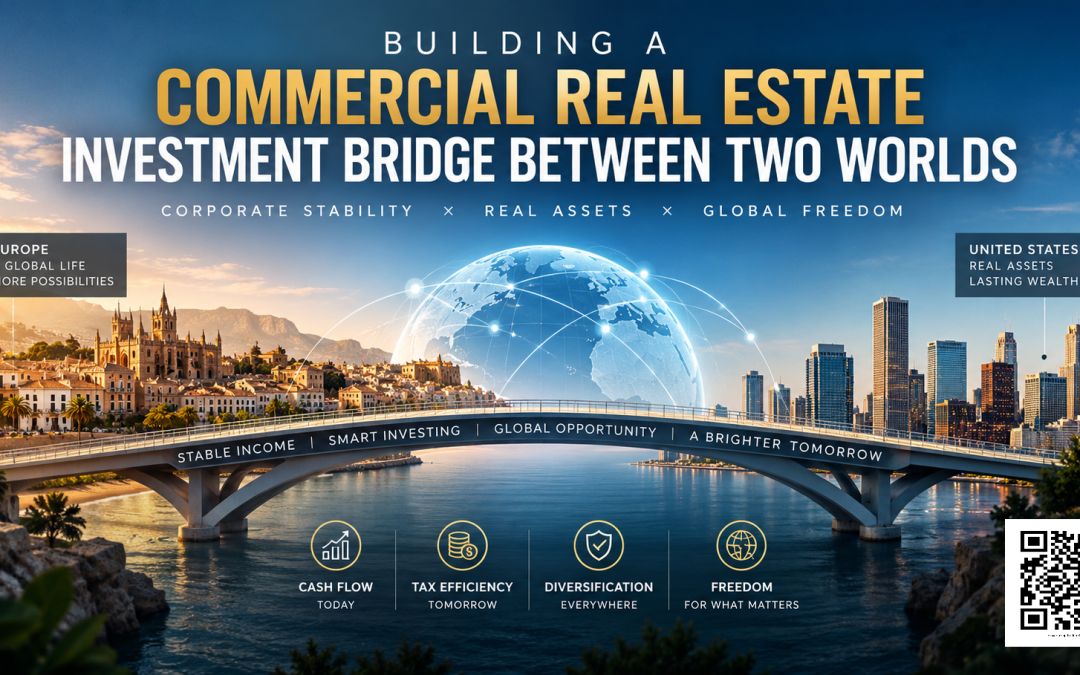
In today’s interconnected economy, the most successful investors are no longer limited by geography, job titles, or traditional financial structures. Commercial real estate (CRE) investing has evolved into a global, flexible, and highly strategic wealth building vehicle, especially for high income professionals seeking diversification, tax efficiency, and long term freedom.
One compelling example of this evolution is the journey of Billy Keels, an international investor and syndicator who has successfully bridged two traditionally separate worlds: the W2 corporate career and active and passive commercial real estate investing.
From Corporate Professional to Global Investor
Billy Keels’ background challenges a common misconception in the investment world: that you must leave your corporate career to succeed in real estate. While maintaining a demanding enterprise software sales role across Europe, the Middle East, and Africa, Billy built a diversified real asset portfolio spanning multifamily housing, mobile home parks, and alternative investments such as ATM portfolios.
Living in Spain while investing primarily in the United States, Billy demonstrates that geography is no longer a barrier. Instead, adaptability, systems, and strong teams are the true drivers of scalable success.
This “power of AND,” working a high level job while building wealth outside of it, is a central theme for modern investors who want optionality rather than obligation.
Why Commercial Real Estate Appeals to High Income Earners
For many high income earners, the challenge isn’t earning money. It’s keeping it. Traditional vehicles like 401(k)s and IRAs often defer taxes but still expose investors to market volatility and future ordinary income tax rates.
Commercial real estate offers a different approach:
- Predictable cash flow
- Inflation hedging
- Depreciation and tax efficiency
- Greater control compared to public markets
Billy highlights how many professionals begin investing to regain control after experiencing significant portfolio losses during major market downturns, such as the dot com crash and the 2008 financial crisis.
Understanding the 506(c) Investment Structure
A pivotal step in Billy’s journey was launching a 506(c) syndication, a structure that allows accredited investors to participate in private placements while enabling sponsors to publicly market opportunities.
Accredited investors generally qualify by:
- Earning $200,000 or more individually or $300,000 or more jointly for the past two years, or
- Holding a net worth exceeding $1 million, excluding a primary residence
Through this structure, Billy has focused on socially conscious investments that target double digit returns while also addressing ordinary income tax exposure, an especially relevant issue for professionals earning multiple six figures.
Passive Income Beyond Apartments: The ATM Strategy
While multifamily and mobile home parks remain staples of many CRE portfolios, Billy also highlights ATM investments as an underappreciated cash flow strategy.
ATM portfolios function similarly to real estate:
- Machines are physical, income producing assets
- Revenue is generated through transaction fees
- Investors benefit from monthly cash flow
- Depreciation and cost segregation can enhance tax efficiency
For investors seeking diversification and consistent income without operational intensity, ATM investments can serve as a complementary asset class within a broader real estate strategy.
Bridging the Gap: Corporate Stability and Financial Freedom
Perhaps the most powerful takeaway from Billy’s experience is not about a specific deal type. It’s about mindset.
By applying corporate skills such as strategic planning, team building, delegation, and systems management, Billy created financial independence without abandoning professional fulfillment. The result is choice: working because you want to, not because you have to.
This approach aligns closely with the principles outlined in Rich Dad Poor Dad and the Cashflow Quadrant, where true wealth is built by shifting income from time based labor to asset based ownership.
The Future of CRE Investing
Looking ahead, Billy sees growing opportunity in:
- Impact driven investments
- Energy and infrastructure assets
- Solutions tailored to high income earners
- Tax efficient strategies that preserve capital and time
As more professionals seek alignment between income, impact, and lifestyle, commercial real estate will continue to serve as a bridge, connecting traditional careers with lasting financial freedom.
Final Thoughts
Building wealth today is no longer about choosing one path. It’s about integration, combining stable income, smart investing, global perspective, and strategic tax planning.
By embracing adaptability, leveraging teams, and keeping capital actively working, investors can design a life that delivers both purpose and prosperity, no matter which continent they call home.