
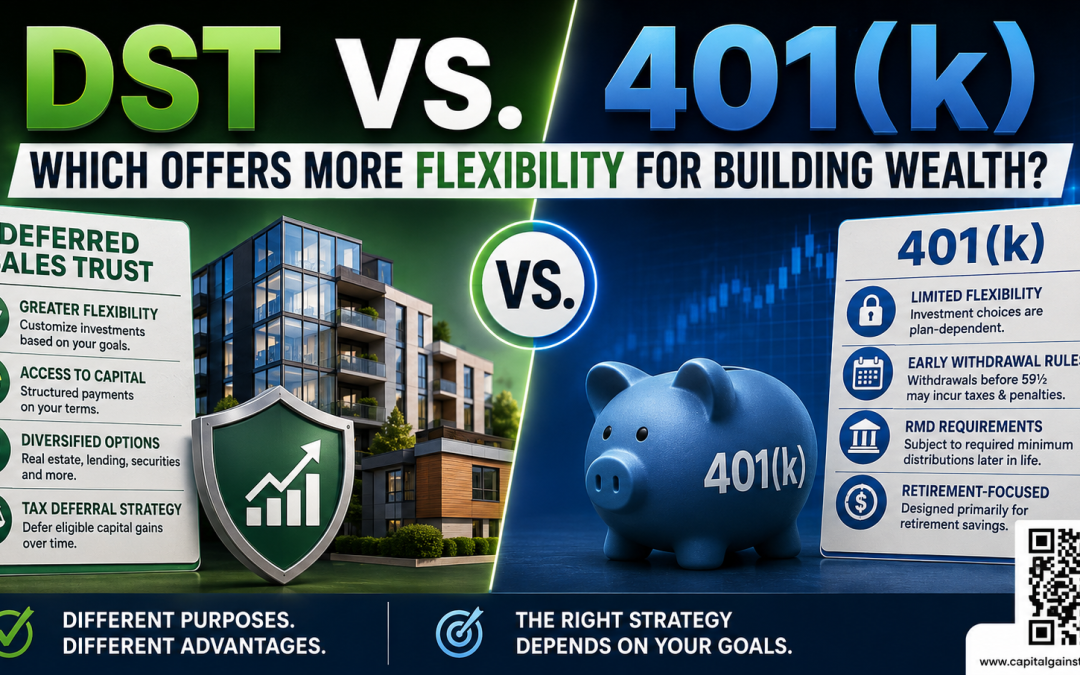
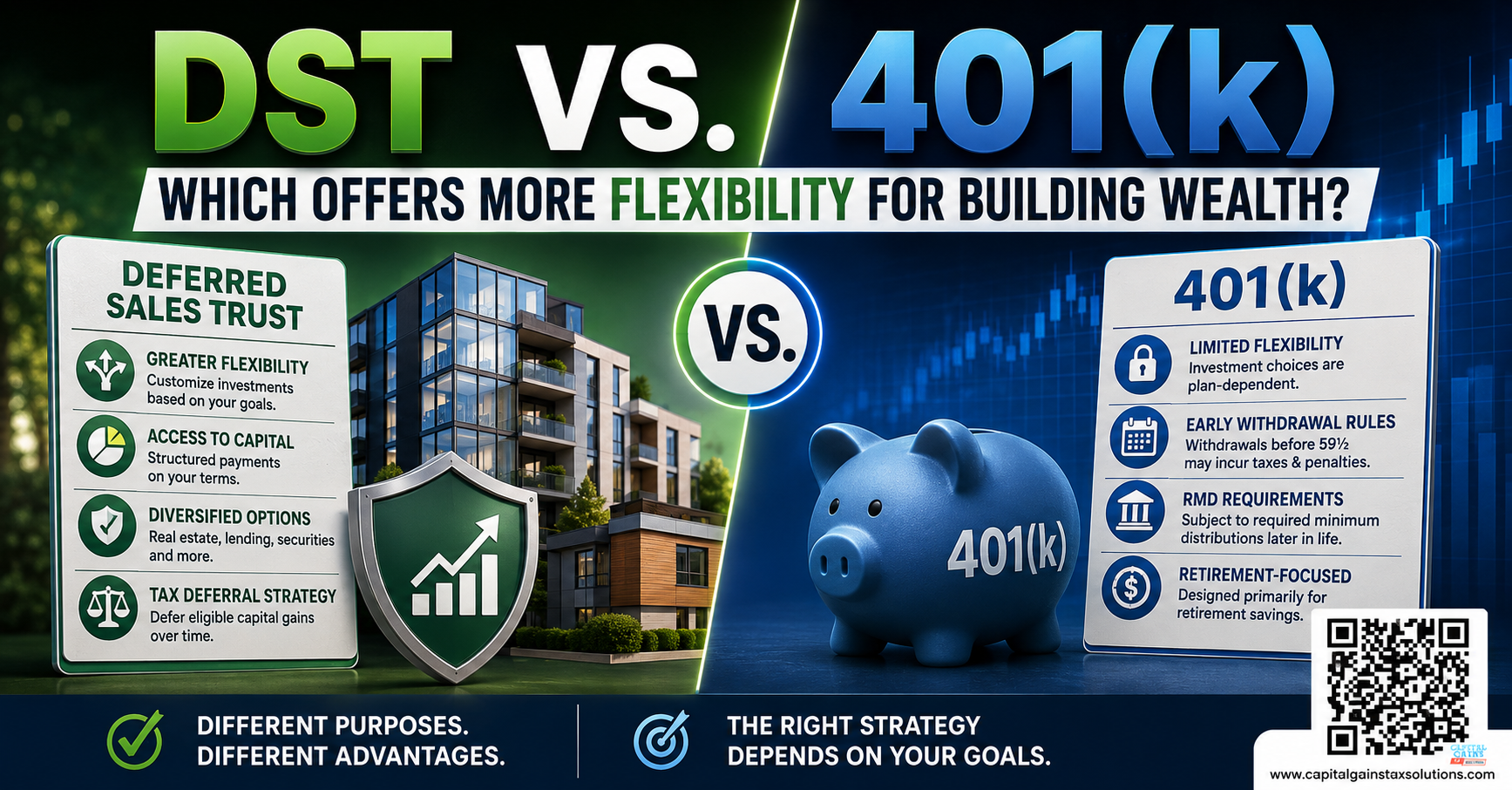
If you’re thinking about building real wealth and eventually hitting that millionaire milestone, chances are you’ve heard a lot about 401(k) plans and maybe a bit about the Deferred Sales Trust (DST). Both are powerful tools that can help you grow your money but the big question is: which one gives you the most flexibility and control?
Let’s break it down in plain English.
What’s a 401(k), Really?
A 401(k) is the go-to retirement account for most people. You contribute pre-tax money, meaning you don’t pay taxes on what you put in at least not right now. This allows you to invest a little extra since that money would have otherwise gone to the IRS. The idea is that your contributions grow tax-deferred until you retire, usually after age 59½. At that point, you’ll start taking withdrawals and pay taxes on them as income.
And if your employer offers a 401(k) match, that’s basically free money. For example, if you put in $10,000 and your employer matches it dollar-for-dollar, you’ve just doubled your investment instantly. Not bad, right?
However, the 401(k) comes with strings attached. You can’t touch the funds before 59½ without paying a 10% early withdrawal penalty (plus income taxes). You’re also forced to take distributions starting at age 70½, even if you don’t need the money yet. That’s where the DST comes in with a lot more flexibility.
Enter the Deferred Sales Trust (DST)
The Deferred Sales Trust is a financial strategy designed to help investors defer capital gains taxes when selling a highly appreciated asset like real estate, a business, or even cryptocurrency. Instead of paying up to 25–50% in taxes right away, the money from the sale goes into the trust, where it can be reinvested before taxes are due.
This means your full sale proceeds keep working for you instead of shrinking from a big tax hit. You can then live off the interest payments from the trust while the principal continues to grow.
Here’s where the flexibility gets exciting:
You can invest through the DST in active or passive real estate, stocks and bonds, mutual funds, or even cryptocurrency. You can remain entrepreneurial or completely hands-off. There’s no contribution limit like a 401(k) you could sell a $10 million property or a $100 million business, and the DST can handle it.
And unlike the 401(k), you’re not forced to take money out at a specific age. You can start receiving payments whenever it makes the most sense for your tax flow and lifestyle.
Tax Flow vs. Cash Flow — The Real Wealth Secret
Here’s something most financial advisors don’t emphasize enough: it’s not just about cash flow; it’s about tax flow. Managing when and how you pay taxes can be a game-changer.
For example, one of Brett Swarts’ clients sold an $8 million property in California. Instead of paying nearly 45% in combined state and federal taxes, he used a Deferred Sales Trust. That allowed him to delay payments (and the taxes that come with them), then move to Nevada, where there’s no state income tax. Now his interest payments from the trust are taxed at a much lower rate and he’s keeping more of what he earns.
You simply can’t do that kind of strategic tax planning with a traditional 401(k).
DST vs. 401(k): The Key Differences Explained
When comparing a DST and a 401(k), the contrasts are clear. 401(k) limits your annual contributions around $23,000 per year (as of 2025) whereas a Deferred Sales Trust has no contribution limits at all. Whether you’re selling a million-dollar property or a hundred-million-dollar business, you can use the DST to defer capital gains taxes.
The 401(k) gives you tax deferral on your contributions until retirement, but you’ll eventually pay income tax when you start withdrawing funds. With a DST, the deferral applies to capital gains taxes, and you only pay taxes when you actually receive payments.
Another major difference is access. With a 401(k), you face stiff penalties usually 10% plus taxes if you withdraw before age 59½. The DST, however, allows much more flexible access. You can structure payouts on your terms without early withdrawal penalties.
Investment options are also broader with a DST. Instead of being confined to mutual funds or ETFs like in most 401(k) plans, you can direct DST funds into real estate deals, businesses, diversified securities, or even crypto.
Finally, while a 401(k) requires mandatory distributions at age 70½, the DST doesn’t. You control when and how you take payments. On top of that, a DST can be passed to your heirs, allowing them to continue the tax deferral a major estate planning advantage that a 401(k) simply doesn’t offer.
What About Market Risk and Future Taxes?
With both strategies, market risk and future tax rates are unknowns. No one can predict where taxes will be 30 years from now. But the DST gives you more control. You can choose when to receive payments, where to invest, and even what state to live in to minimize taxes. Plus, you can pass the trust to your heirs, who can continue the tax deferral a huge advantage for wealth preservation and long-term estate planning.
The Bottom Line
If your main goal is long-term retirement savings with predictable contributions and an employer match, a 401(k) is a solid, simple choice.
But if you’re selling a highly appreciated asset and want maximum flexibility, control, and tax deferral, the Deferred Sales Trust may be the smarter move. It’s not just about saving on taxes it’s about unlocking your wealth strategically, so your money keeps working for you.
Ready to Learn More?
To explore how a Deferred Sales Trust can help you defer taxes, diversify investments, and build lasting wealth, visit CapitalGainsTaxSolutions.com or check out Brett Swarts’ Capital Gains Tax Solutions Podcast.
Remember, wealth isn’t just what you earn. It’s what you keep, grow, and pass on.