We’ve talked frequently about Deferred Sales Trusts (DST) and how they can be a powerful and flexible capital gains tax deferral strategy. If you need to get caught up, read about Deferred Sales Trusts here.
You already know the basics, but you have questions before you decide to use a Deferred Sales Trust for your next real estate, Bitcoin, or business sale. The good news is that we have answers.
We are here to answer the most common questions about Deferred Sales Trusts so that you are informed and prepared when you meet with your tax attorney or trustee.
Why Have I Never Heard of this Before, and Why Hasn’t My Tax Advisor Recommended it to Me?
This is the number one question we get from potential clients. They come to us saying, “This sounds too good to be true.” They’ve worked with smart and capable tax advisors, attorneys, and CPAs, and they have never heard of a Deferred Sales Trust.
We have found that many CPAs and tax attorneys have heard of it, but they don’t have experience using it or only have peripheral knowledge. Understandably, they are cautious about recommending a strategy they don’t fully understand.
The Deferred Sales Trust is a protected strategy. Tax professionals using this strategy are subject to non-disclosure agreements. So, if your financial advisor or CPA have not had a live client with a live case, therefore opening up the opportunity to sign and an NDA and dig in to people, process and tax code behind the DST, they probably don’t have the knowledge to recommend the strategy fully.
You should know that the Deferred Sales Trust has a close to 30-year history with thousands of closes and a perfect legal track record with over two and half dozen audits at the state and federal levels. All of those audits have closed with no changes. The Deferred Sales Trust is protected because the professionals who use it want to keep it from being abused or misused, have it fail an audit, and have the IRS take away this incredibly effective strategy.
Is a Deferred Sales Trust a “Tax Loophole?”
Deferred Sales Trusts fall under section 435 of the IRS tax code, and sellers have been using installment sales for a long time. Private letter rulings and many audits closed without change demonstrate that according to the IRS, the Deferred Sales Trust is not a tax loophole but a legitimate and legal tax strategy.
Is a Deferred Sales Trust the Same as a Monetized Installment Sale?
The IRS has recently cracked down on monetized installment sales, making many investors nervous about using a deferred sales trust. They are not the same thing.
In simplest terms, a monetized installment sale “loans” the total sale price amount back to the seller for a minimal interest rate. For example, if I wanted to sell a $10 million asset using a monetized installment sale, the trust would sell to a buyer on my behalf, and the $10 million would go into a trust. The trust then loans me the full $10 million, and I have to pay them a low interest rate, say 3%, in return. The reason the IRS doesn’t like this is because I have taken actual possession of the full $10 million and used a loophole to get around the capital gains taxes.
In contrast, if I were to use a Deferred Sales Trust, the trust would take possession of the $10 million, and I would not have realized any actual gains at that time. The trust can reinvest the $10 million on my behalf and according to my wishes, but I don’t have complete control over the money the way I would with a monetized installment sale. I will only pay taxes on the portion of the gains I receive each year through the installments agreed upon before the sale. A Deferred Sales Trust isn’t a loophole to avoid taxes; it is a legal method of deferring taxes.
Can I Decide the Amount of Payment I Receive or Where My Proceeds are Invested?
Before you sell your asset, you will work with the Deferred Sales Trust trustee to precisely determine the installment note’s terms. The trustee will work with you, your financial advisor, tax attorneys, and CPAs to build a trust structure based on your income needs, goals, risk tolerance, and personal desires. The amount of principal paid, the frequency of installments, and the choice of investments are all subject to your approval.
Can the Payment Timing and Amount Change After the Sale and DST is Setup?
Yes, the promissory payment amount and timing can be changed with the approval of the DST trustee. The noted can be extended or shorten, payment increased or decreased for the principal payments, or move to an interest-only payment or partial interest payment. The trust can also be unwound and closed which means you would likely take receipt of any unpaid principal and interest due to you. Just keep in mind that you would immediately owe the capital gains taxes and ordinary income taxes based on your gain from the original adjusted basis and unpaid interest.
Which Assets Qualify for a Deferred Sales Trust?
Unlike a 1031 exchange, the Deferred Sales Trust can be used with a wide variety of assets. You can use a Deferred Sales Trust anytime the sale of your asset results in a capital gain of at least $1 million. This applies to commercial real estate, primary residences, farmland businesses, Bitcoin, stocks, and art and collectibles.
If I Use a Deferred Sales Trust to Sell a Property, Can I Use the Proceeds to Buy Another Property?
Of course! A Deferred Sales Trust is an effective alternative to a 1031 exchange. When you use a 1031 exchange, you are subject to strict guidelines regarding the type of property you can reinvest in and a strict timeline to find and purchase your replacement property. This isn’t the case with a Deferred Sales Trust. You can reinvest your proceeds into a primary residence, apartments, farmland, or commercial real estate. You have the flexibility to buy a new property right away or keep your funds in trust until you find the right property at the right price.
I Want to Find Out if This Works for Me. What Do I Do Next?
If you want to see if a Deferred Sales Trust works for you, contact a qualified and experienced Deferred Sales Trust Trustee. Capital Gains Tax Solutions offers free consultations to see if a DST can help you defer your capital gains taxes and maximize your returns.
Video

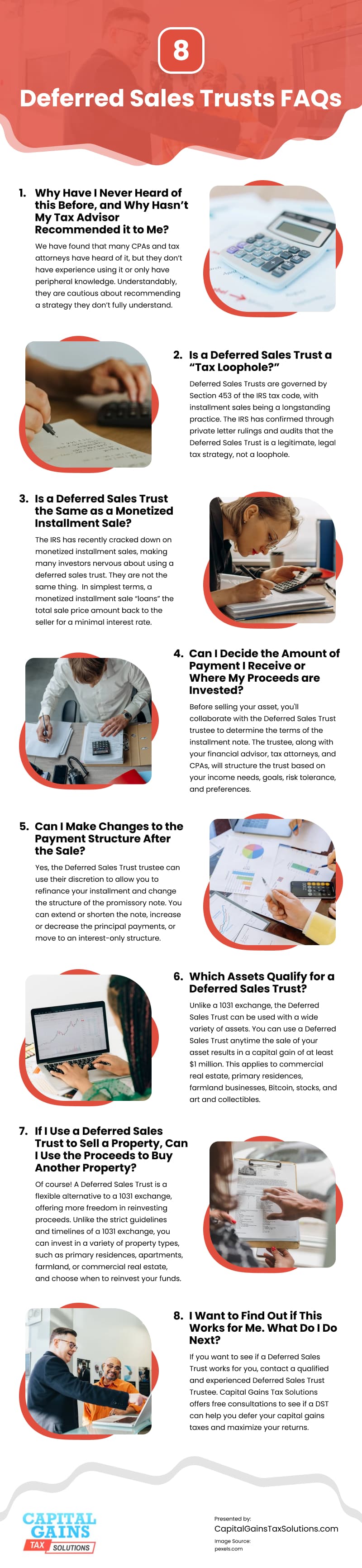
Infographic
You’re familiar with the basics, but you may have questions about using a Deferred Sales Trust for your next real estate, Bitcoin, or business sale. This infographic covers common questions to help you prepare for your meeting with your tax attorney or trustee.