
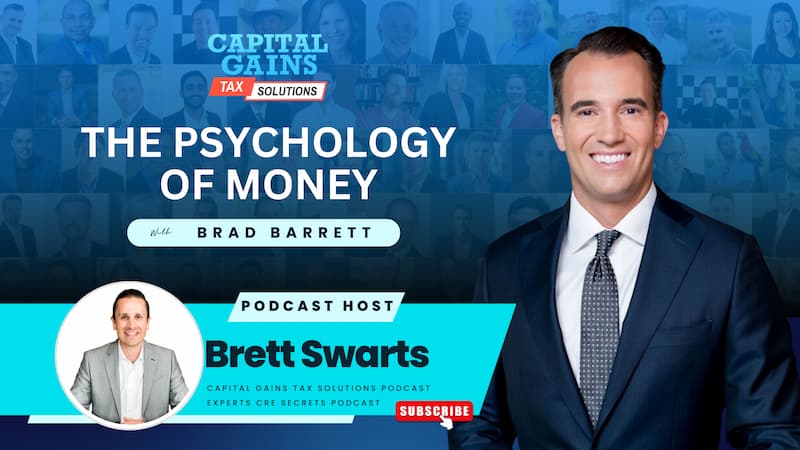
Brad Barrett is a Managing Director and Partner at One Capital Management, LLC, a private wealth advisory firm managing $5 Billion in Assets. With nearly 20 years in the financial services industry, he is passionate about finding new ways
to educate investors.
He Having the heart of a teacher, He shares his knowledge and experience through his weekly YouTube, Podcast and Radio Show, “Make Your Money Matter”. His show aims to change the way people think about financial advice, so they can make better decisions with their money.
A sought-after public speaker, Brad has educated thousands of people planning for financial freedom across the country. His book, Retire Right, hit the shelves in 2021 and serves as a guideline to aligning goals and objectives when it comes to investment and financial planning.
Brad has a bachelor’s degree in Economics and Political Science from Arizona State University. He is a CERTIFIED FINANCIAL PLANNERTM and member of Kingdom Advisors.
Episode Highlights Here:
Brett
I think the number one thing that most people get wrong about money is that they actually think it has some metric in our life to do the things we want to do you see is the number one secret read to the psychology of money?
Brad
You know, so it’s funny, I actually started talking a lot about this probably 10 years ago, as I realized that at that point, I was 10 years into the business with working with clients. And, you know, I came into this business, like a lot of us do, really, with the numerical data, how to know all these numbers, these equations, how to invest and all these things, right. And what I found, after about 10 years of doing it, was a lot of clients’ worries. And a lot of our worries as humans really had a little bit less to do with the quality of the quantitative data, it had a lot more to do with the qualitative. And this is like the interest, the goals, the relationships, the values, we all carry, and monies we all know is just the tool, right? It is not the thing, it is just something that we use to do the things we want to do. And so what’s interesting about a couple years ago, in fact, the book psychology of money, was written by a guy named Morgan Housel. And I absolutely fell in love with it. So essentially, we’re even titling that because I don’t know if you’ve read that book before, Brett. But it’s an amazing book, I would recommend it for anybody and everybody, I’ve read it multiple times. And it’s just a great example of there’s plenty of studies on psychology and money that goes back way back, I have plenty of books behind me on the psychology of money. But that one was so cool, because it laid it out and wrote it so well, in my opinion, with anecdotal evidence, stories, and just different things. And I think the number one thing that most people get wrong about money is that they actually think it has some metric in our life to do the things we want to do. And I’ve seen it time and time again, with clients, that if they obtain that theory, or whatever that money is that monetary goal, there’s, again, it’s a great thing, we always tend to like move the goalposts and we do that in our life as well. And I think it’s important financial advising, that we talk about that and just kind of we start here, one, Capital Management with a conversation of What’s your why with a client. And we do that simply because when someone comes in and meets with us, we want to understand who they are, you know, and it’s, again, it’s less questions or, you know, items, we need to gather around the numbers, their income, their debts, their assets, those are important. But we’re also trying to figure out who what their behavioral financial, like DNA is like, they’ve all they come into our office, they met with us via zoom, and they have a history they’ve they’re coming in from somewhere, you know, I just said, but I had the other day, I had a great example, within a week span of a review meeting with clients. I had one client who very clearly shared with me that, you know, he wants to spend every dollar he can when he can, he’s totally live in the live for now moment, right, because his parents would save, save, save. And then like seven months after he retired, his dad passed away unexpectedly, mom went two years later. So his view of money was very much like I want to spend it. I understand saving, investing, but I want to spend it. And the literally the week later, I was having a review with a client, we were talking about estate planning and legacy planning conversations. And through that discovery with a new it was a newer client, we were realizing that their parents were 97 and 99 years old, and in full health. So in their mind, they were so focused on longevity. And so it was just a great example of two polar opposites when you talk about planning, and it’s a great example and a story to share that we’re all different. And I think the way we treat money needs to be different as well. And so that enters into the psychology of how we individually perceive money, what it means to us, what we want from it. And ultimately, we want to end up paying off the one thing we all know we want is time. You know, it’s the one commodity in life. We can’t get back. I speak about it often. My one parlor trick is I can tell someone I can I can prove to you that you care about time more than money. Because if a 95 year old today came to you and said, Hey, man, I’ll trade you places I’ll give you $10 billion, and I’ll trade you places permanently. And I’d ask someone would you do that? The answer would likely be No. If you’re 60 years old, and you answer that question, you would lose 35 years of your life time matters more and so understanding your why understanding how where you’re sick, not just psychology in general, by the way, there’s plenty of studies on that, but your psychology and I think a good adviser can ask the right questions get into the mindset help you understand your goals and objectives with money because most clients come in they’re not totally entirely sure right. So we want to help them get to that point by asking the right questions, understanding who they are meeting with them kneecap to kneecap, empathizing with them understanding their story because everyone has a financial story. Some people grew up you know on food stamps, some people grew up on silver spoons. We want to understand there’s two different walks of life out there many different walks of life frankly. So I think the psychology Money plays into the right questions being asked in an introductory meeting with an advisor and then ultimately, how you would then prepare a financial plan or overall invest your overall portfolio. It also plays into things like taxes and all the other items.
Brett
There we go.
Watch the episode here:
Important Links:
About Brad Barrett

Brad Barrett is a Managing Director and Partner at One Capital Management, LLC, a private wealth advisory firm managing $5 Billion in Assets. With nearly 20 years in the financial services industry, he is passionate about finding new ways to educate investors.
He Having the heart of a teacher, He shares his knowledge and experience through his weekly YouTube, Podcast and Radio Show, “Make Your Money Matter”. His show aims to change the way people think about financial advice, so they can make better decisions with their money.
A sought-after public speaker, Brad has educated thousands of people planning for financial freedom across the country. His book, Retire Right, hit the shelves in 2021 and serves as a guideline to aligning goals and objectives when it comes to investment and financial planning.
Brad has a bachelor’s degree in Economics and Political Science from Arizona State University. He is a CERTIFIED FINANCIAL PLANNERTM and member of Kingdom Advisors.
- capitalgainstaxsolutions.com
- Capital Gains Tax Solutions Facebook
- Capital Gains Tax Solutions Twitter
- Capital Gains Tax Solutions Tiktok