
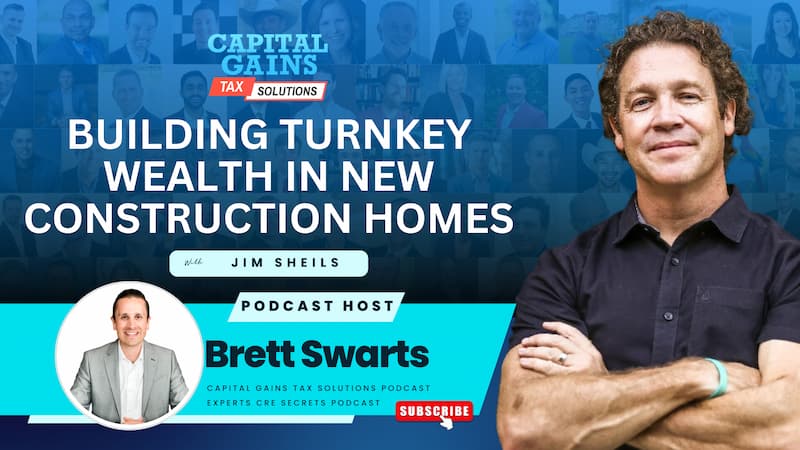
Jim Sheils a seasoned real estate investor with over 22 years of experience and a portfolio of 2,000+ acquisitions and rehabs. From California to Florida, Jim’s expertise has driven success in bulk foreclosure acquisitions and pioneering the “Build To Rent” model. As a full partner at SI Homes, he continues to shape the future of passive income real estate. Beyond investments, Jim is a bestselling author and co-founder of 18 Summers, known for inspiring family talks delivered worldwide.
Episode Highlights Here:
Brett
Absolutely. And I see it’s southern impression homes, by the way to learn more about Jim, you can go there at Southern impression homes.com. And, Jim, we’re seeing a change in the marketplace even now. Right? And so what would you say is the number one secret to making wise investment decisions in today’s marketplace?
Jim
Yeah, I think you still have to look at the fundamentals and the numbers. And that’s one of the key things. And for us, we’re a service provider where people come to us to build a rental portfolio for them, we have to see what the obstacles are. So for us to keep the market healthy, we have to see what the obstacles are and work with them. For example, as you know, I mean, who would have thought interest rates at today’s, you know, interview were at almost 8%. So we actually have in house financing, where we’re spending quite a bit of money to buy down the rates for our people, you know, we’re getting them locked in still in the 5% range. And so that is the type of thing I’ve found to keep the fundamentals going. First of all, you have to look at the real numbers, not the media. The media will poison your brain to get in at the wrong time or get out at the wrong time. But then, if you’re active like we are with providing for investors like you are, you have to see what are the obstacles in the market and then figure out ways to overcome them for your people.
Brett
Doing that makes a lot of sense. Yeah, we’ve seen the inverse of interest rates, you know, from even a year ago, or a year and a half ago now, where Cap rates, you know, you had a positive arbitrage now it’s that negative arbitrage. So I like how you’re being proactive and you’re taking in house by being able to do that financing and buy down the rates. That’s great. Talk about your model built to rent and how do you define that and how do you think it’s going to move forward and Cost of capital for construction with time and time value of money talk about what you’re seeing with that right now.
Jim
Yep, so build to rent is just what it sounds like you build properties with the desired goal to rent them. Now, these properties that we build, again, are very simple, single family homes, duplexes, and quads because all of those can get residential financing. And for most of our investors, residential financing has a lot more longevity and a lower rate, it’s more safe, and that’s what most of our clientele is looking for. And we work in both whole communities where, you know, we will build a whole community for not an individual investor, normally, but a hedge fund or a larger institution. But then we also do something called scattered lots. So we’ll build duplexes or single family homes in an already established neighborhood. And we just buy up all the empty lots in that area, and fill them in with our properties, which has been a really good strategy because I was taught that old school rule, hey, try to go to an established neighborhood where there’s a good mixture of homeowners and renters. And so we keep that going. And that’s our main focus, we built these properties, and we coupled them with high growth markets in Florida. And what constitutes a high growth market. In Florida, there’s five things: population growth, economic growth, the affordability index, this is really key. That’s where the average price for a home is at a good equivalent of what the average family income is per household. So in our markets in Florida, we’re still at a really good affordability index. So that’s super important. Because once that goes out of whack, and cashflow goes away, and our strategy really wouldn’t work, you’re not going to do what we do in parts of California, or even now Utah Salt Lake City, you know, has about the same family income as our average market here in Florida, but they’re buying at the median is like almost $300,000 more, you know, that kills cash flow. And the other things you look for is healthy supply and demand. Since we’re building, we’re going to go to areas where there’s a shortage of housing and desirability, why are people going to move there? You know, you know, obviously, after the lock downs and the craziness we have in the last few years, Florida got a lot of popularity, we’re certain people like the the business climate, they liked the way that they handled it, they liked just the lifestyle warming by the water, you know, is a pretty popular thing. So you want to go to areas that are desirable. So that’s why we focus on new construction in high growth markets defined by those five things.
Brett
Talk about the difference between someone who might invest in the built around with the single duplexes, the quads, right, like the single family, you know, fixed financing for, you know, upwards of 30 years, right. And the ability to perhaps even renew refinancing a little bit a little bit a little simpler than the commercial loans, versus someone investing in a 200 304 unit apartment complex. Just compare and contrast those two, and maybe a valuable way to diversify. Because, you know, I believe diversification within real estate is important as well. It just isn’t diversification. Anything’s important, but especially in the real estate class, talk about, you know, the pros and cons and why that would be a good good mix for somebody.
Jim
Yeah, it all depends on the position and the strategy. You know, if we, you know, we’ve worked with some of the larger groups out there that are owning a lot of properties, and they own apartment buildings as well, but they like our strategy, because it is what’s considered a little more low density, that low density feel where you can set up a whole community. And it’s not quite stacked on top of each other. And since the pandemic, people like a lower density, you know, they want it to be spread out. So we see people wanting that. And it can be a great way to grow. You know, some of our mutual friends have done whole communities. And as long as you can get the commercial financing in place, I think it’s great. The risk that I tell people where a lot of people go with smaller chunks with us, is you know, with apartment buildings right now you’re seeing these guys that syndicated deals, and they got in at some, some pretty aggressive teaser rates. And now they’re set to refi. And they’re not liking the rates. And it’s a pretty scary situation. And you always want to avoid things like that. That’s why we’re kind of the singles and doubles. We’re the tour tortoise next to the hair, with the with bulk residential, because bulk residential, you can usually get a better financing on from what I’ve seen, especially for the smaller groups, but for the bigger groups, you know, they like this whole community approach because it can be managed kind of like a multi, but it’s more spread out. It has a different desirability and also a different clientele who rents it
Watch the episode here:
Important Links:
About Jim Sheils

Jim Sheils is a full-time real estate investor for over twenty two years, completing over 2,000 acquisitions and rehabs. After his start in Bakersfield CA, he came to Florida to follow the long-term growth patterns he was seeing predicted for the southeastern United States.
Post 2008, his company, Jax Wealth Investments focused on bulk foreclosure acquisitions for several years until creating a joint venture with Carter and Chris Funk to focus on the emerging “Build To Rent” model. His expertise in sales, marketing and capital raising were a perfect blend to support Florida’s growing niche. He is also a principal owner of the Island Oak RV Resort, playing a key role in the development and design of this company project.
In 2022, after over $300 million in deals together, Jim came on as a full partner in SI Homes. This dynamic partnership has enabled him to better develop key initiatives and relationships with both clients and strategic partners.
“Passive income real estate has changed the direction of my life and so many of our clients’ lives. I have every intention to keep doing it and on an even larger scale for all involved.”
Jim’s own real estate investments have allowed him to travel the world with his beautiful wife and five children. It gave him the space and ability to donate a kidney to his father and enjoy his favorite pastime of surfing. He is also active in many charities and service organizations.
In addition to real estate, Jim is co-founder of the company 18 Summers and best-selling author of the popular book “The Family Board Meeting”. His family talks have been delivered on stages worldwide and are a matching core value for our team and many of our clients.
- capitalgainstaxsolutions.com
- Capital Gains Tax Solutions Facebook
- Capital Gains Tax Solutions Twitter
- Capital Gains Tax Solutions Tiktok